
NAVI Leads FUT AC 8-2 Across Five Modes

NAVI leads FUT AC 8-2 in a Brawlytics practice snapshot dated October 1. The aggregate is built from three clean 2-0 rows for NAVI and two tied modes. That split matters: FUT AC stays level in Bounty and Hot Zone, while Heist, Brawl Ball and Gem Grab create the full difference.
Brawlytics lists the teams in FUT AC–NAVI order. Bounty opens 1-1, Heist moves 0-2, Hot Zone returns to 1-1, and both Brawl Ball and Gem Grab finish 0-2. Adding the five rows produces two points for FUT AC and eight for NAVI. No mode row shows FUT AC ahead, but two rows are shared evenly.
This is a dated scrim card with completion unconfirmed. It is not an official tournament score and should not be converted into a claim about standings. Its value is narrower and more practical: it shows exactly which displayed modes separated the teams during this segment of practice.
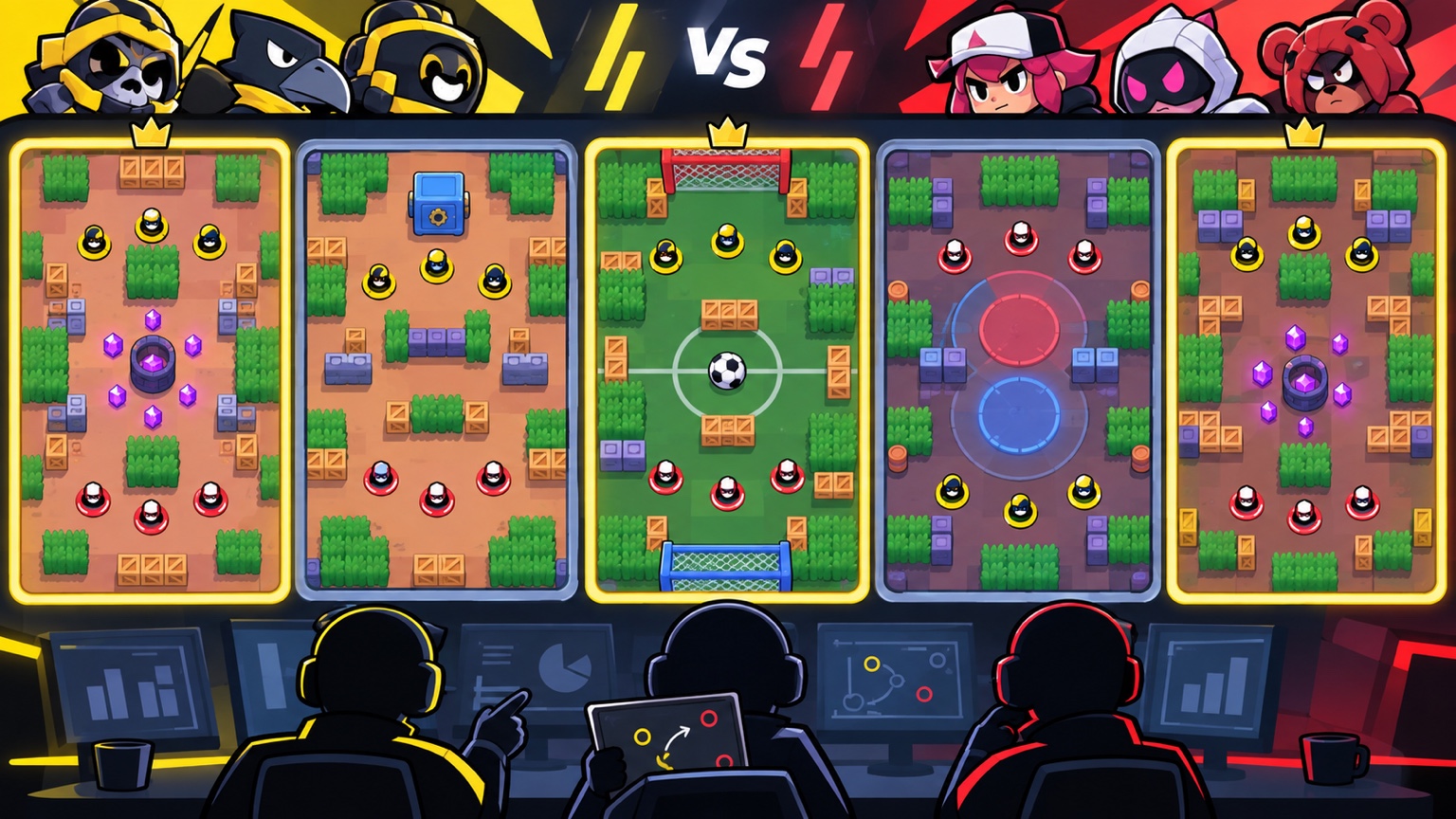
Three 2-0 rows build NAVI’s advantage
Heist, Brawl Ball and Gem Grab each contribute two unanswered points to NAVI. Together they create a six-point net margin. Bounty and Hot Zone add one point to each team and contribute equally to the total. The final 8-2 total is therefore easy to trace. The public score card contains mode results; maps, drafts and player actions require separate replay evidence.
The winning modes also ask different questions. Heist concerns pressure and defense around the safe. Brawl Ball places more emphasis on space and conversion near the goal. Gem Grab requires resource control and a safe close. A clean row across all three may be worth comparing for common decisions, but the visible data cannot prove that one cause produced every result.
FUT AC has two useful anchors in the tied modes. Bounty and Hot Zone show that the session was not an uninterrupted sequence of losing rows. Review can begin by identifying what allowed the team to trade points there, then checking whether the same spacing, draft balance or communication was absent in the 0-2 modes.
For NAVI, the task is to preserve the process without overreading the score. A broad practice lead is helpful only if the repeatable decisions are understood. The team can compare the opening control, mid-game adjustments and closing sequences across its three clean modes. If the wins relied on different solutions, each belongs in a separate preparation note.
A useful baseline for the next meeting
The clearest future comparison is not simply whether NAVI leads again. A later card can show whether FUT AC turns one of the clean losses into a tied row, whether NAVI converts one of the ties, or whether the mode mix changes entirely. Those details reveal movement that an aggregate comparison can miss.
Readers sharing the result should retain the team order because the original page lists FUT AC first. Stating that NAVI leads 8-2 is accurate only when the reversed wording is handled carefully. The October 1 date, practice label and unconfirmed completion status should remain attached as well.
- Read the original card in FUT AC–NAVI order before restating the aggregate.
- Focus NAVI review on the three clean 2-0 modes.
- Use Bounty and Hot Zone as FUT AC’s baseline because both are tied 1-1.

| Mode | FUT AC | NAVI |
|---|---|---|
| Bounty | 1 | 1 |
| Heist | 0 | 2 |
| Hot Zone | 1 | 1 |
| Brawl Ball | 0 | 2 |
| Gem Grab | 0 | 2 |
NAVI’s 8-2 practice lead comes from a precise pattern. Heist, Brawl Ball and Gem Grab are all 2-0, while Bounty and Hot Zone are tied. That makes the review more informative than the aggregate alone. NAVI has three different objective environments in which to identify repeatable decisions. FUT AC has two even rows that can serve as a stable comparison and three clean losses that can be separated into smaller problems. The card remains a scrim snapshot with completion unconfirmed, so neither an official result nor a lasting hierarchy follows from it. Used responsibly, it provides a strong dated baseline: six points of net separation, three NAVI-led modes and two shared modes that show where FUT AC remained competitive. The next dated practice card can be compared against each row separately, allowing progress to remain visible even if the overall score moves only slightly.